Maintenance
Alternator vs. Battery: Diagnosing Heavy-Duty Electrical Failures on the Road
⚡ Quick Answer: How to tell if it's the battery or the alternator?
If your semi-truck clicks or refuses to crank but your lights work fine once jumped, your batteries are likely dead or degraded. If your truck starts up fine but experiences dimming dashboard lights, dropping voltage gauges, or dies completely while idling, your alternator is failing to charge the system.
When you are hauling a heavy load through Indiana, an unexpected electrical failure can instantly derail your schedule. A "no-start" condition is one of the most frustrating breakdown scenarios because the symptoms of a dead battery pack and a failing alternator look almost identical on the surface.
Understanding how to accurately diagnose the root cause saves you hours of diagnostic guesswork and prevents unnecessary component replacement. If you find yourself stranded at a truck stop or on the shoulder, securing a rapid commercial truck jump-start service can get your system tested and back online immediately.
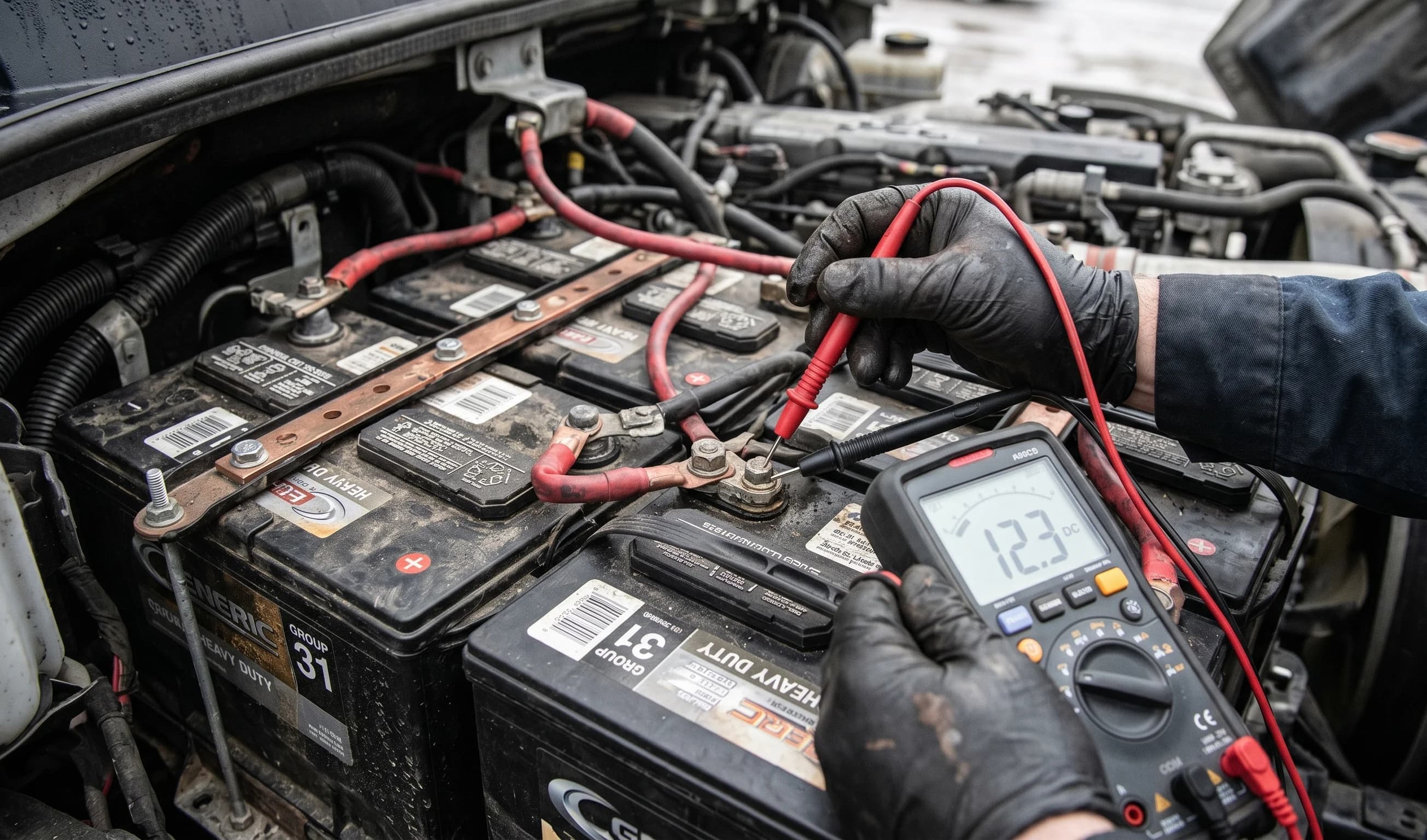
1. The Heavy-Duty Battery Pack: Symptoms of Failure
Commercial trucks rely on a bank of three or four Group 31 batteries connected in parallel to provide the massive Cold Cranking Amps (CCA) required to roll over a heavy-duty diesel engine.
Key Indicators Your Batteries Are Dead:
- The Rapid Click: When you turn the ignition key, you hear a rapid clicking sound from the starter solenoid. This indicates there is enough voltage to engage the solenoid, but not enough amperage to turn the flywheel.
- Corroded Connections: High vibration from highway driving can loosen battery terminals or cause acid leaks, leading to heavy corrosion (green/white buildup) at the terminals, choking off power delivery.
- Voltage Drop Under Load: A healthy 12V system should read around 12.6V at rest. If your voltage drops below 9.6V while attempting to crank the engine, the battery cells can no longer hold a load.
2. The Alternator: Symptoms of a Charging System Failure
The alternator is the heart of your truck's electrical grid while the engine is running. It converts mechanical energy from the serpentine belt into electrical energy to power your electronics and continuously recharge your battery bank.
Key Indicators Your Alternator is Failing:
- Dropping Voltmeter: Keep a close eye on your dashboard gauge. A properly functioning alternator should output between 13.8V and 14.4V while running. If your gauge steadily drops toward 12V or lower while driving, the alternator is not outputting power.
- Dimming or Flickering Lights: If your headlights, dashboard display, or sleeper berth cabin lights dim significantly when you drop to an idle, the system is running strictly off remaining battery reserve power.
- The Battery Warning Light: The dashboard battery icon or a "LOW VOLTAGE" warning light is triggered by the Engine Control Module (ECM) when it detects that the charging system output has dropped below the threshold required to sustain the truck's electrical load.
3. The 60-Second Roadside Test
If your truck stalls out or won't start, you can perform a quick diagnostic check if you have a basic digital multimeter:
- Test Resting Voltage: Turn off all accessories and read the voltage across the battery bank. If it is under 12V, the batteries are discharged.
- Jump the Truck: Connect an external power source to start the engine.
- Test Running Voltage: With the engine running, place the voltmeter leads back on the batteries. If the meter still reads 12.2V–12.5V, your alternator is dead. If it immediately jumps up to 14.0V, your alternator is working perfectly, meaning your batteries are failing to hold the charge.
Need On-Site Electrical or Battery Support?
Electrical issues rarely fix themselves. Whether you need an emergency jump-start, a roadside battery pack replacement, or an on-site alternator swap, our mobile service units are fully equipped to handle heavy-duty electrical failures 24/7.
We provide rapid, professional roadside repair directly across major Indiana transit corridors, including Indianapolis, Greenwood, Plainfield, and Terre Haute. Call our dispatch team to get a technician sent to your exact mile marker.